

A story read aloud, with the word lit as it is spoken.
LimaRead is a reading app for children and the people who read with them. Fairy tales, fables and nineteenth-century classics — and every one of them exists in six languages. Books download to the device and work with no connection.
See how it reads For parents Prices
Free: the first six books in every language and reading group. On Google Play and the App Store.

See it work
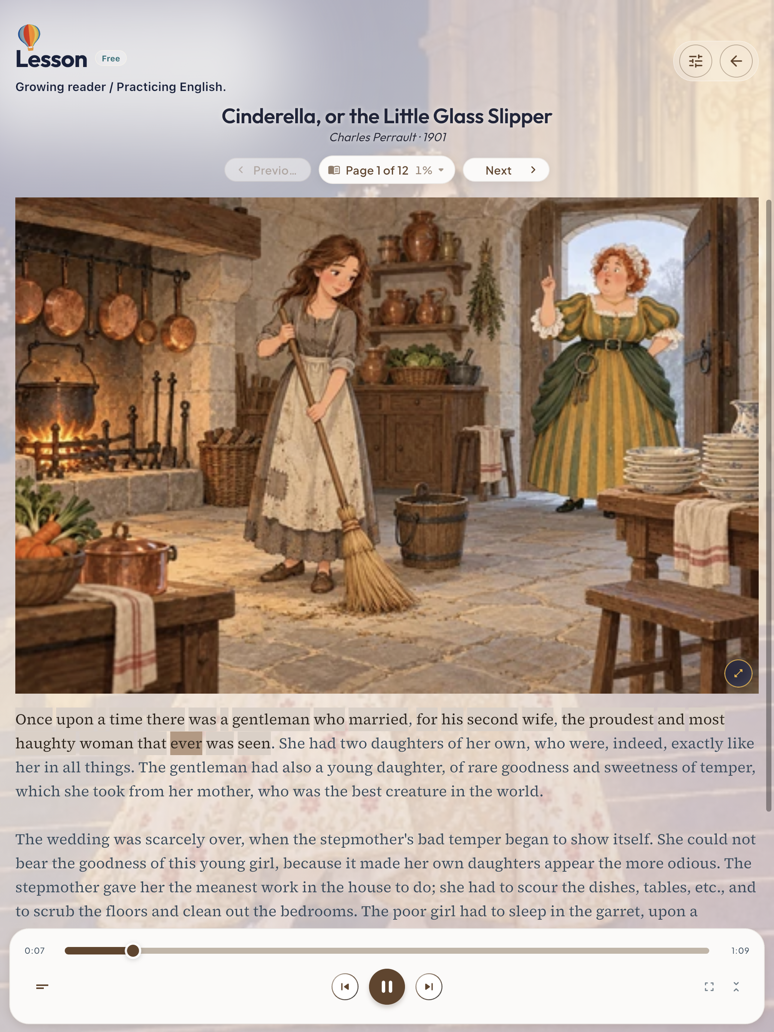
Open a story, press play, and the voice begins. This is the real app, reading Cinderella aloud.

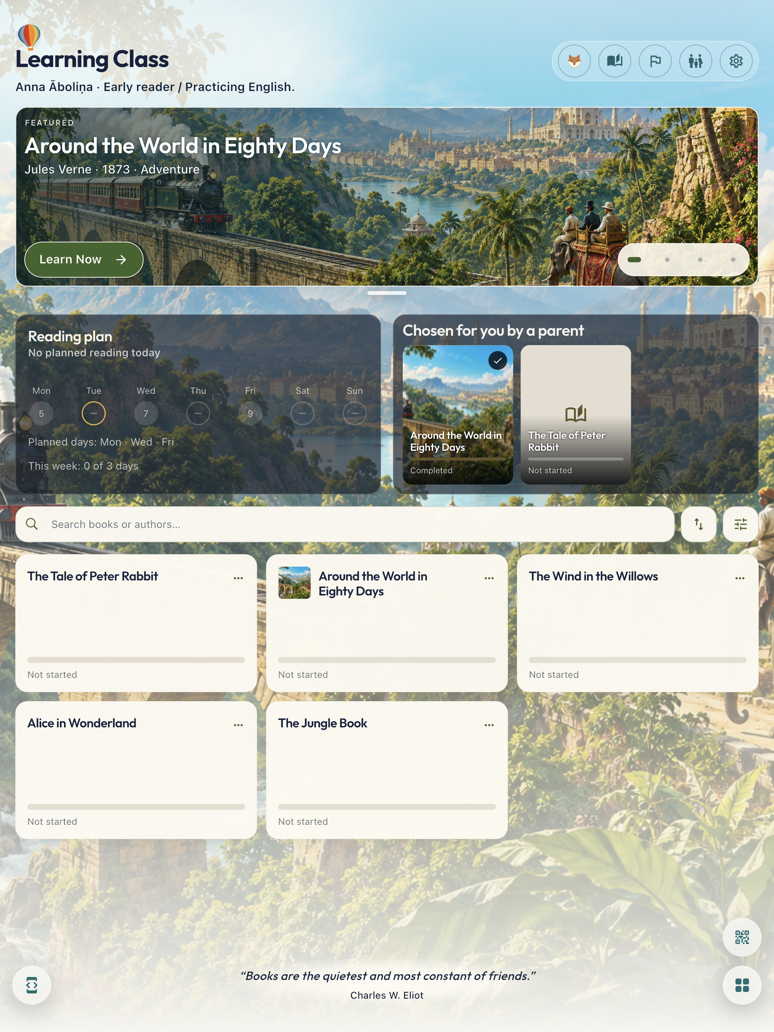
- 0:00 The Learning Class shelf: the reading plan, what to continue and the parent’s choices.
- 0:17 Opening a story.
- 0:20 Sentence mode: one sentence at a time.
- 0:48 Say it again.
- 1:05 The family overview.
- 1:15 The weekly report.
-
Follow the light. The word being spoken is lit as it goes, so a child’s eyes stay exactly where the voice is.
-
Tap any word. Tap a word to hear it again, as many times as it takes.
-
Repeat until it is easy. Have a sentence read again and again, until it comes without effort.
What a child actually does
They tap a book. The voice starts. The word being spoken lights up, and the page keeps pace with it.
Once upon a time there lived in a certain village a little country girl.
How reading works
One page of Cinderella, read two ways. In Sentence mode the voice reads one sentence and waits, so a child can hear it again or go on. In Flow mode it reads straight through.

- 0:00 Cinderella, page 1.
- 0:02 Sentence mode: one sentence, then it waits for you.
- 0:12 Hear it again, as often as you like.
- 0:22 Then on to the next.
- 0:33 Three ways to read.
- 0:40 Flow mode: the whole story, no stops.
Three ways to be read to
Flow reads the page straight through. Sentence reads one sentence and waits. Word by word reads one word and waits, and a word can be played again as many times as a child wants.
Tapping a word sends the voice to it. The speed can be set to three quarters, normal or a quarter faster, and the text can be made a little smaller or a good deal larger.
A real voice, where there is one
Where a story carries a recorded human reading, the timing of every word was measured against it — that is what the light is following. Where there is no recording, the device's own voice reads instead, and the app says so rather than letting you think otherwise.
A recorded reading shows on the lock screen and in the car, and carries on with the screen off.
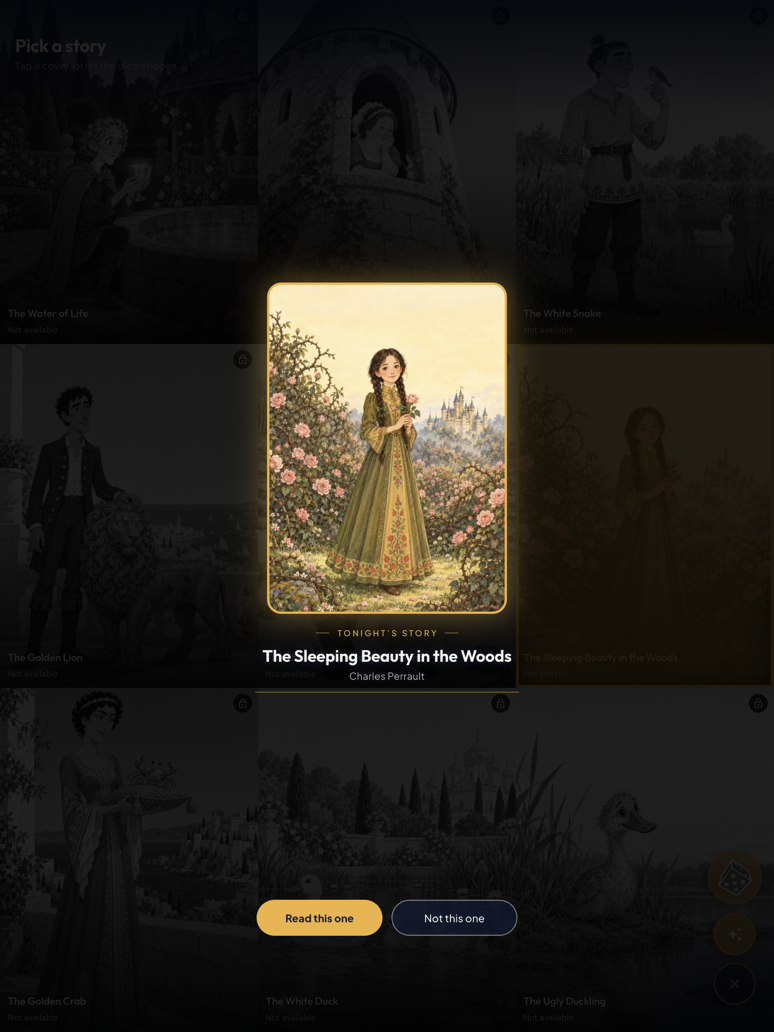
When nobody can decide what to read
A way of being handed a story instead of choosing one: the whole shelf as covers in three columns that spin and come to rest, with one held up as tonight's story. The story is an offer, not an order — the book opens only when the child says yes to it. And the shelf itself is always there to be browsed.
The shelf, panel by panel
Above the grid of books the shelf keeps a few short rows of its own: the book left open, a handful picked for this child, the featured one across the top, and a search row for when you know what you want. Inside a book, the pictures can be looked at on their own and the way of being read to is chosen before the voice starts.


It is not the same app at six and at sixteen
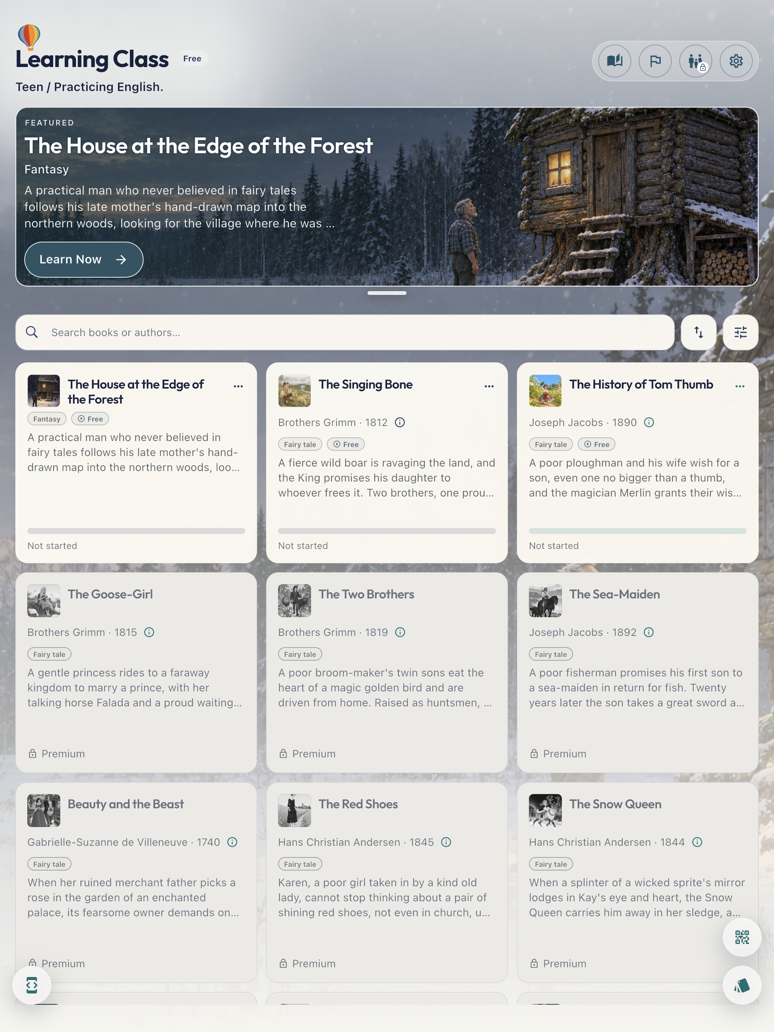
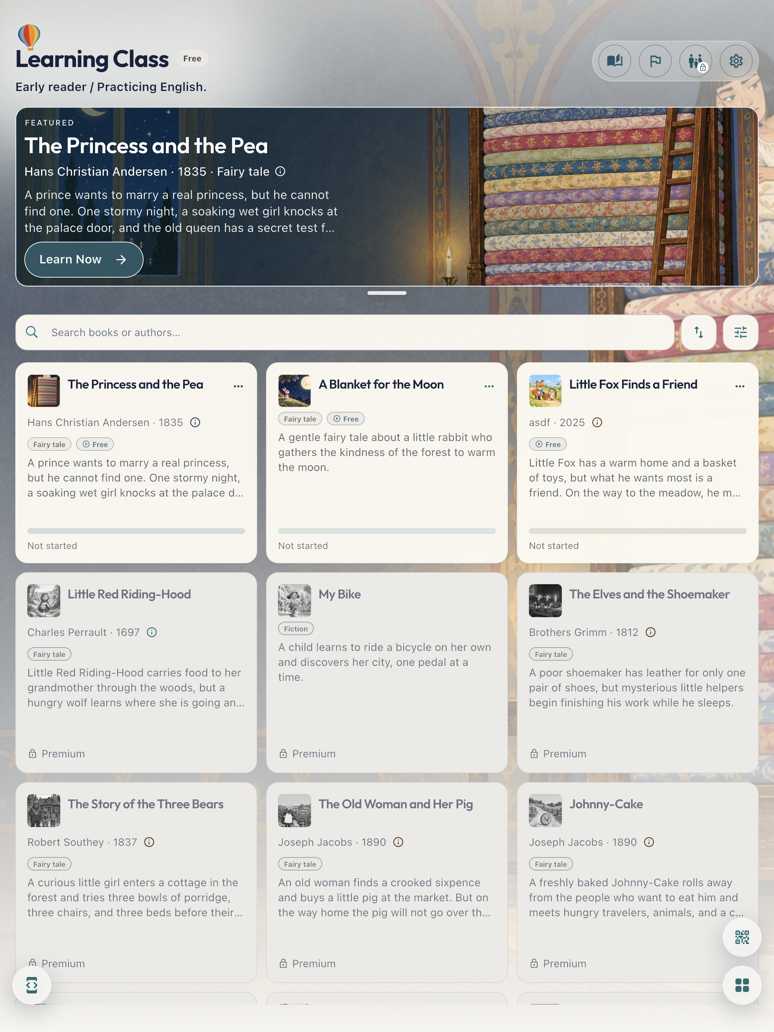
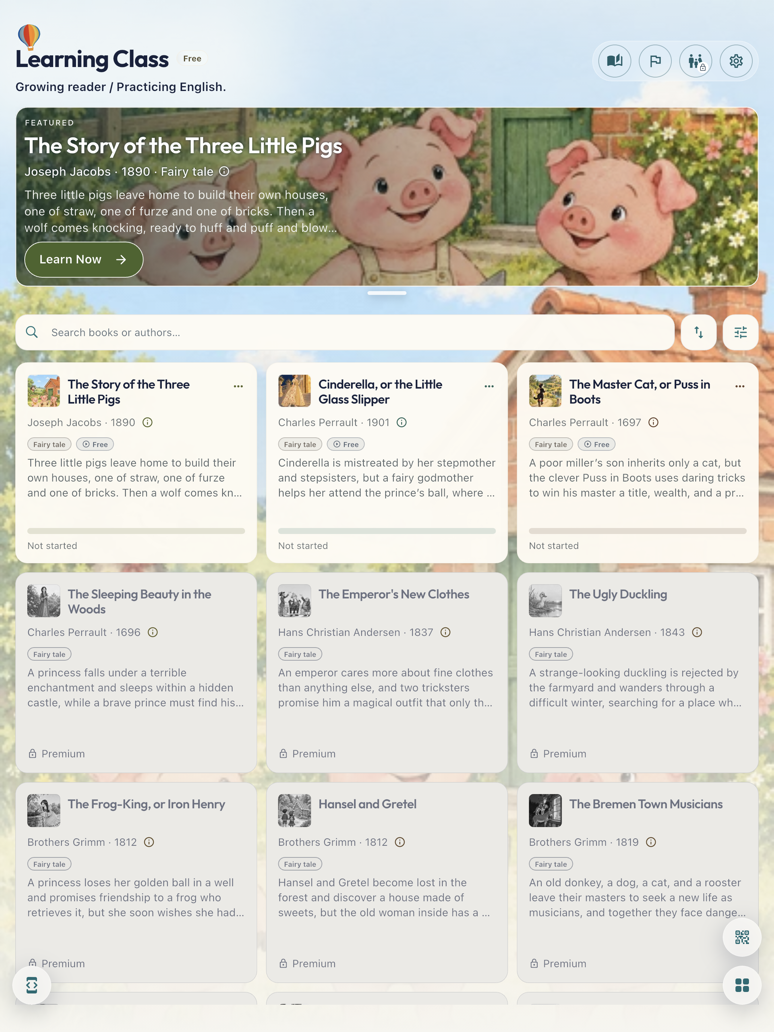
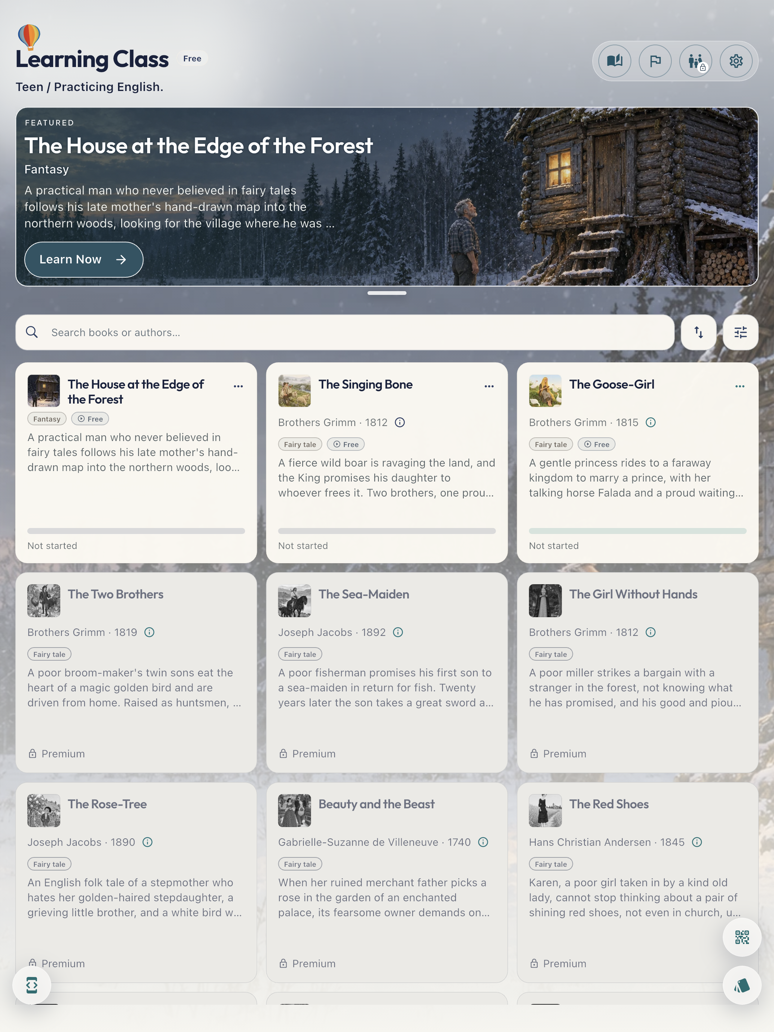
A child is set to one of three reading stages, and the stage decides both what is on the shelf and how the page that opens off it is laid out. Below is one application on one tablet, photographed at all three.
Three shelves
The same screen with three catalogues behind it. What a six-year-old is offered is not what a fifteen-year-old is offered, and neither of them has to scroll past the other's books to reach their own.
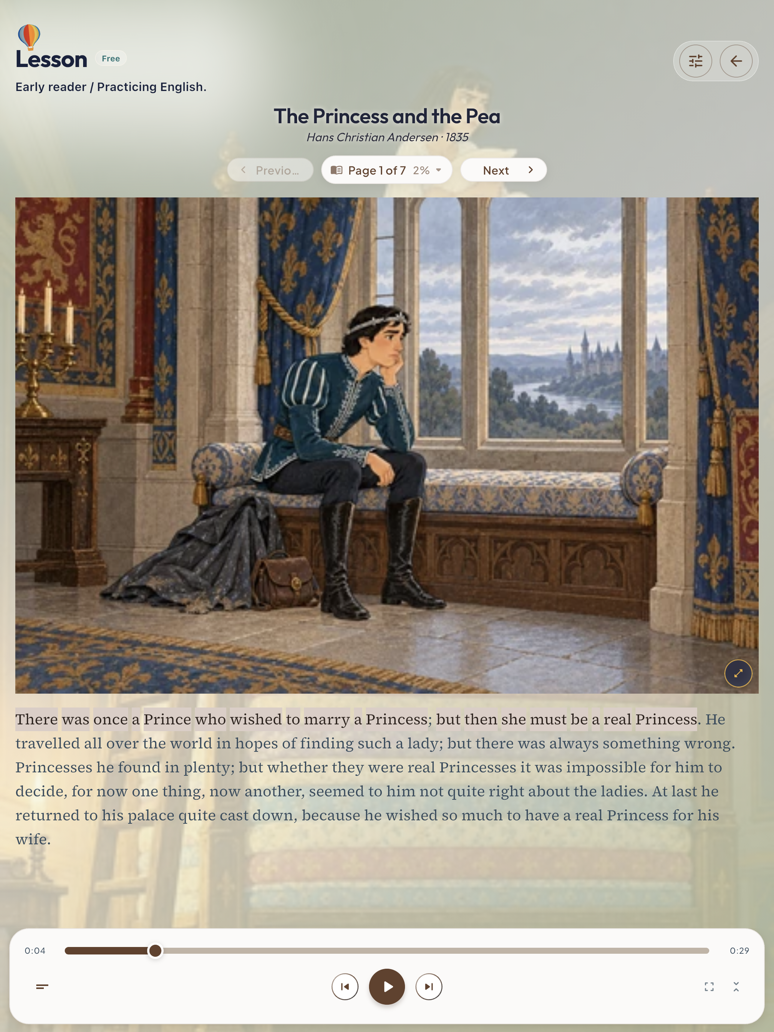
Three pages
And the story itself. At the early stage a page is one large picture with five lines of big type under it, and the tale is cut into seven such pages. By the teen stage the picture has made room for smaller type and more of it, and a long story is a couple of pages. In every one of them the sentence the voice is on is lifted out of the rest.
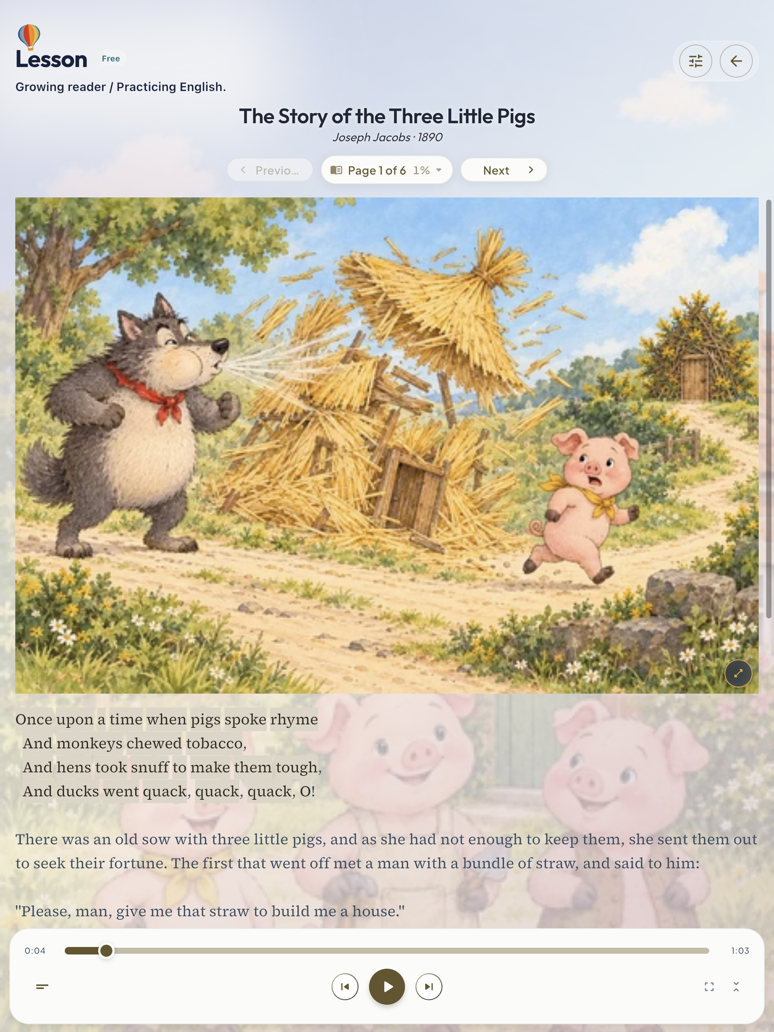
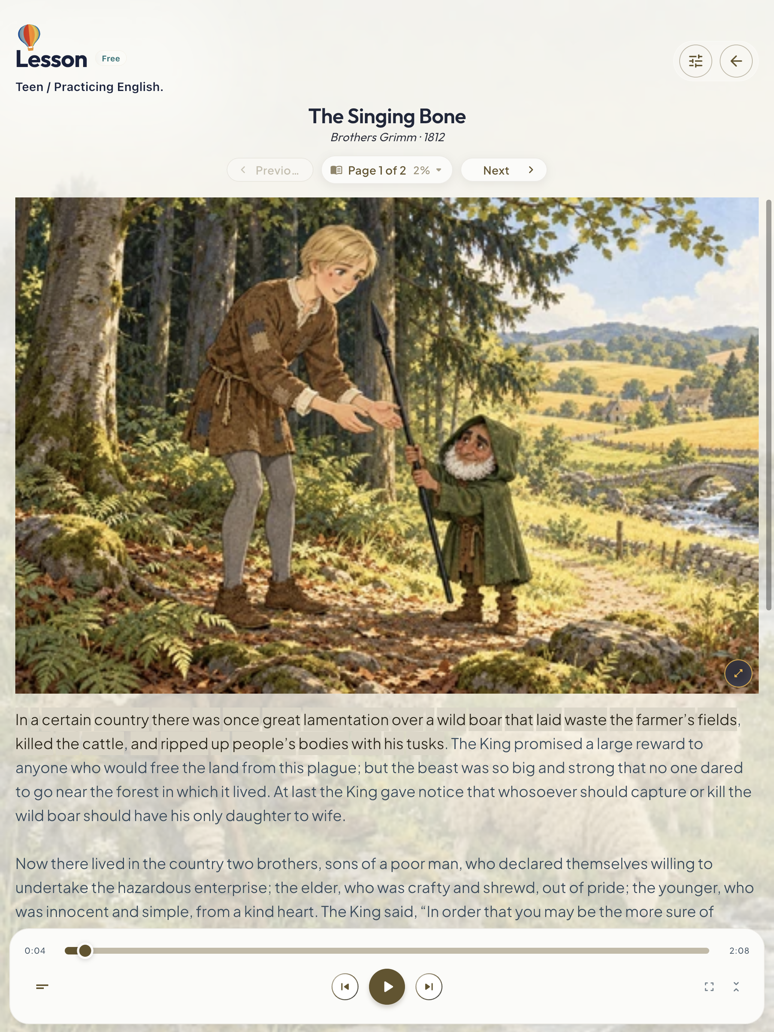
A stage changes how big the buttons are, how much is on one screen and how much ceremony there is — not how good the stories are. It is a setting in preferences, not a judgement, and it can be moved back as easily as forward.
Every book carries a level
Besides its reading stage, every story is graded A1 to C2 — the scale language courses use — in each language it exists in. The letter on the card says how hard the words are; the stage says who the story is for.
What the letters mean
- A1 Beginner
- The simplest texts: short sentences, everyday words, one thing happening at a time.
- A2 Elementary
- Short tales where one refrain carries most of the words; a child who reads a little can follow.
- B1 Intermediate
- Plain storytelling in the past tense, concrete things, the odd idiom explained by what happens next.
- B2 Upper-intermediate
- The nineteenth-century register: long sentences, formal speech, words nobody uses today. Where most of the classics sit.
- C1 Advanced
- Allegory, archaic phrasing and long reported speech; best read with a grown-up or a dictionary nearby.
- C2 Proficient
- A handful of texts that are hard in any language — Poe, Basile — for the reader who wants them.
How the stories fall, in each language
The same story is not the same level everywhere: a tale that is B1 in German may be B2 in French. The weight sits on B1 and B2 in every language, because most of the stories are nineteenth-century texts and that is simply what their register is. The easy end is the modern, purpose-written stories and the cumulative tales.
| Language | A1 | A2 | B1 | B2 | C1 | C2 |
|---|---|---|---|---|---|---|
| English | 1 | 9 | 42 | 58 | 5 | 1 |
| Deutsch | 4 | 10 | 50 | 44 | 6 | 2 |
| Français | 1 | 5 | 33 | 63 | 10 | 4 |
| Русский | 3 | 10 | 47 | 46 | 8 | 2 |
| Español | 4 | 10 | 47 | 48 | 5 | 2 |
| Italiano | 1 | 5 | 33 | 64 | 11 | 2 |
How a story is graded
The levels were read, not computed. Each text was judged from two samples, its opening and its middle, together with measurements of the whole — length, sentence length, word length and the spread of its vocabulary — and where the measurements and the prose disagreed, the prose decided. One rater took one language, and all of them worked from the same written rubric, each with a caution about what misleads in that language: German words are long because they compound, Russian sentences count short, and in French and Italian the narrative past tense matters more than any sentence length.
The level is not the stage. The stage was decided on content and tone first, then length, then interest, with difficulty last as a tiebreaker — a tale can be linguistically simple and still be about a child being eaten. So a shelf for six-year-olds holds B1 books, and a teen shelf holds the odd A2.
How a parent uses them
The letter sits on every card beside the free or premium mark, so it is the first thing a reader checks before the description. It follows the practice language: switch the child to French and the same book may wear a different letter, because it is a different text. A book the catalogue has not graded yet simply carries no letter.
In the search row's Filters, under Reading level, the shelf can be narrowed to one letter — and only the letters the shelf actually holds are offered, so a filter never leads to an empty Library. The free books are the first six in every language and reading group whatever their level; a subscription opens the rest, at every level.
The same app, in a pocket
On an iPhone nothing is left out. The page sets everything a size smaller, keeps its buttons in the title line, and the word still lights as it is spoken.


The phone gets the same shelf, the same three stages, the same voice and the same family pages as the tablet, laid out one thing to a row. A book downloaded on one plays on the other, and the family can be moved between them as one file.
The same story, in six languages
Not six different libraries. The same stories, each one written out in all six — so a child can read a story in the language they have, and then meet the very same story in the one they are learning.
Little Red Riding-Hood
Once upon a time there lived in a certain village a little country girl, the prettiest creature that ever was seen.
Rotkäppchen
Es war einmal in einem Dorf ein kleines Bauernmädchen, das hübscheste Geschöpf, das man je gesehen hatte.
Le Petit Chaperon rouge
Il était une fois, dans un village, une petite fille de la campagne, la plus jolie qu’on ait jamais vue.
Красная Шапочка
Жила-была в одной деревне маленькая крестьянская девочка, такая хорошенькая, что лучше неё никого на свете не было.
Caperucita Roja
Érase una vez, en cierta aldea, una niña campesina, la criatura más bonita que jamás se había visto.
Cappuccetto Rosso
C’era una volta, in un villaggio, una bambina di campagna, la più graziosa che si fosse mai vista.
Each translation is a translation, made for reading aloud and recorded in that language — not the English words with subtitles under them.
New on the shelf
Books are added all the time. Lit bulbs are already on the shelf; the others are on their way.
This is only a demonstration: a few sample books show how the “New on the shelf” screen in the app looks. The dates of the books still to come are examples, not announcements.
What a parent gets
A subscription opens the whole library and the family side of the app. These six things are what it is for.
What your child gets is simple: a story read aloud while the word being spoken lights up, in the language they have and the one they are learning, at a level set for their age. What you get is a quiet way to see that it is happening.
For parents: what you see and control
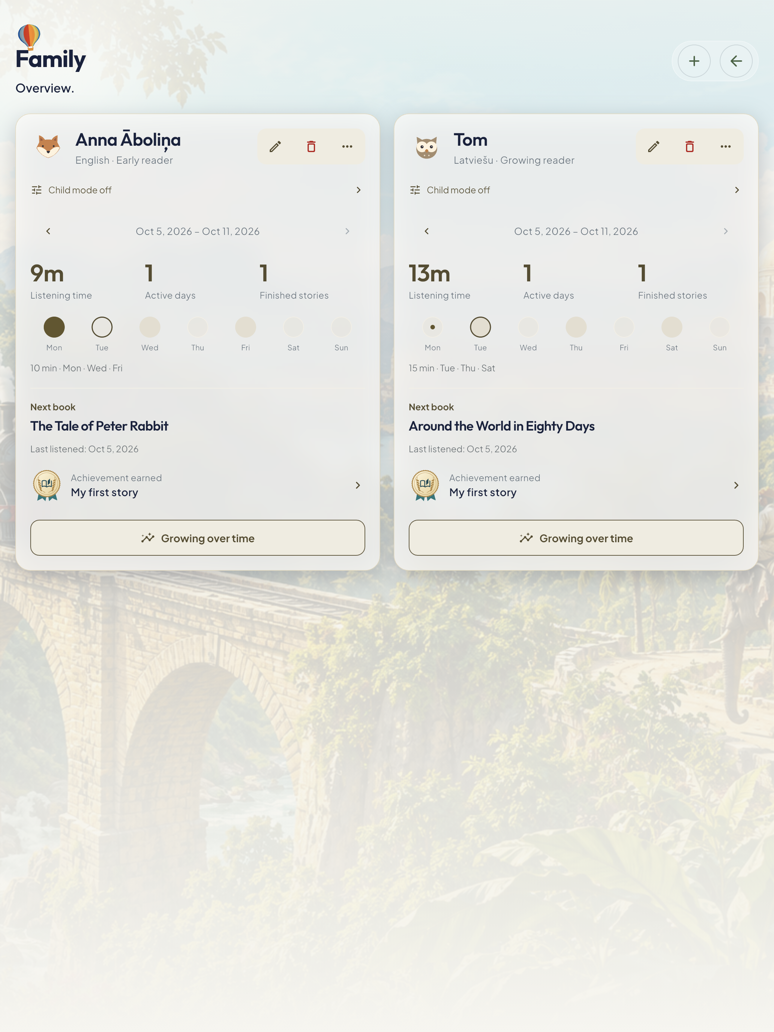
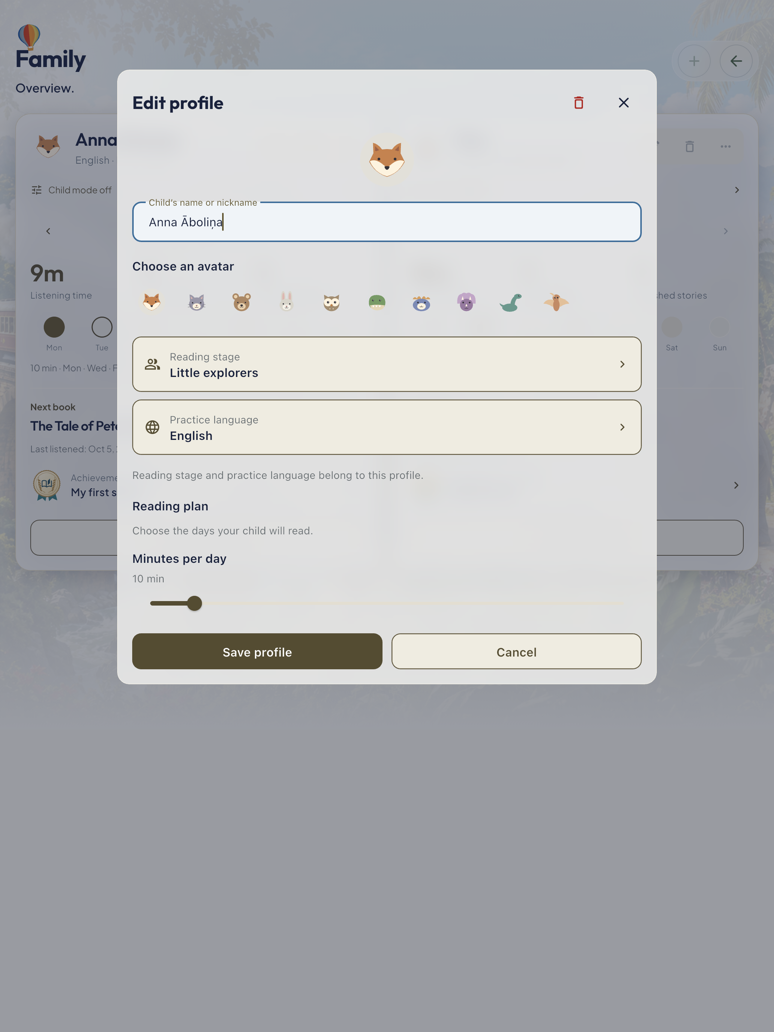
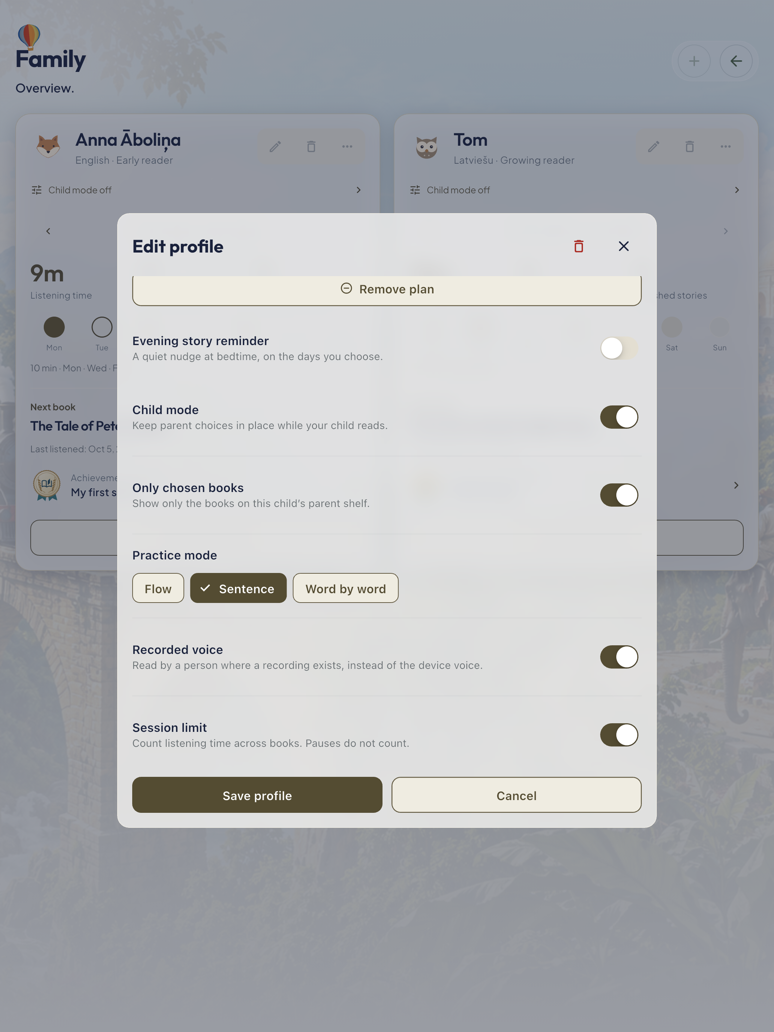
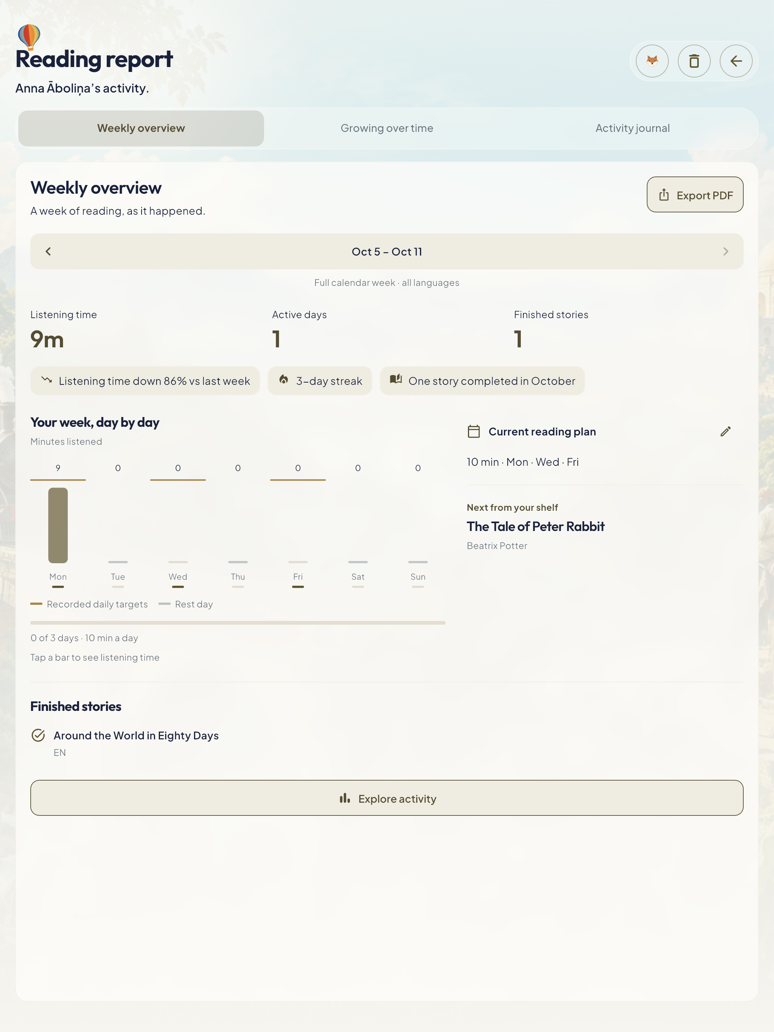
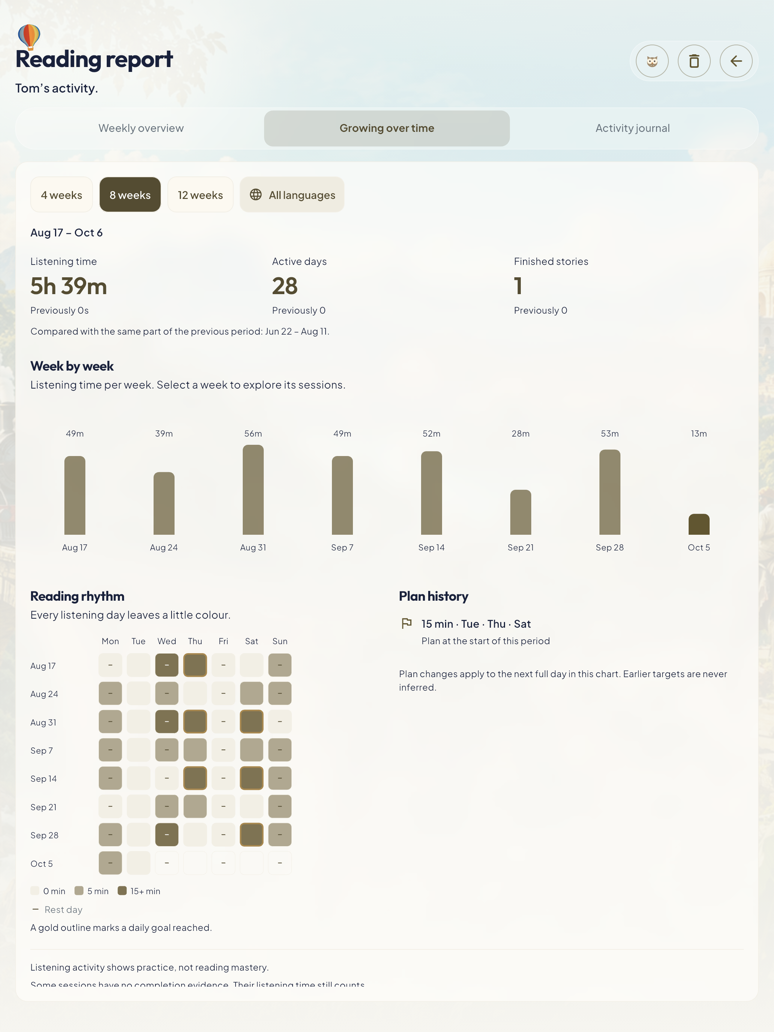
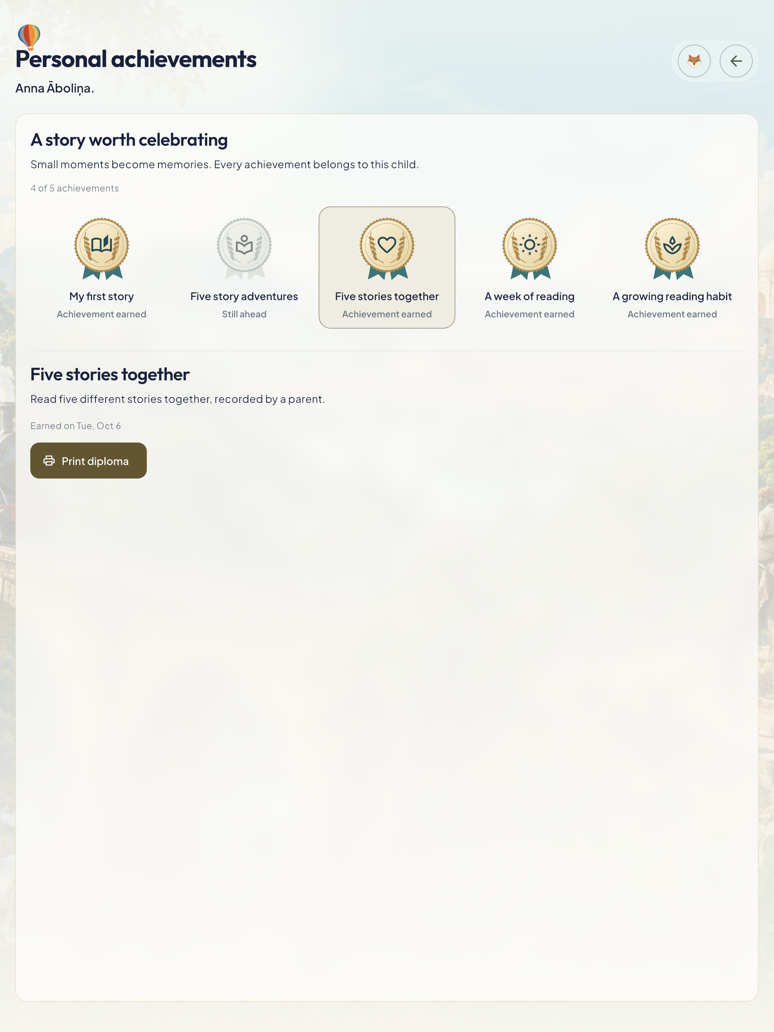
The Learning Class as a parent has set it up, the family overview with each child, the weekly report, what was listened to, how a child grows over time, and a child's profile.

- 0:00 The Learning Class, set up by a parent: the plan, continue reading, chosen books.
- 0:21 The family overview: every child at a glance.
- 0:31 A child's weekly report.
- 0:39 What was listened to: the activity journal.
- 0:49 How a child grows over time.
- 1:01 Editing a child's profile.
-
All books
Explore every story in every language and reading group.
-
Weekly report
Listening time, active days and finished books, week by week, with a PDF you can keep or share.
-
Child profiles
Each child keeps their own progress, language and listening history.
-
Reading plans and chosen books
Set a weekly goal and choose the next books for each child.
-
Child mode
A calm reading space for your child; parent settings stay behind a PIN.
-
Offline listening
Download books and listen anywhere, with no connection.
Around a book
What a book offers besides being read: what can be done with it, who wrote it, what it takes up on the device, when it was listened to — and, for a reader on Free, the one offer the app makes and then stops making.


The numbers describe practice, not ability
The report counts time only while the voice is actually moving — a paused book, a book left open on a table and a book loading all count as nothing. A story is finished when nearly every page of it has really been played, not when the last page was reached. No score, no reading age, no judgement about your child is inferred anywhere, because the app has no business making one.
Reading stages, not grades
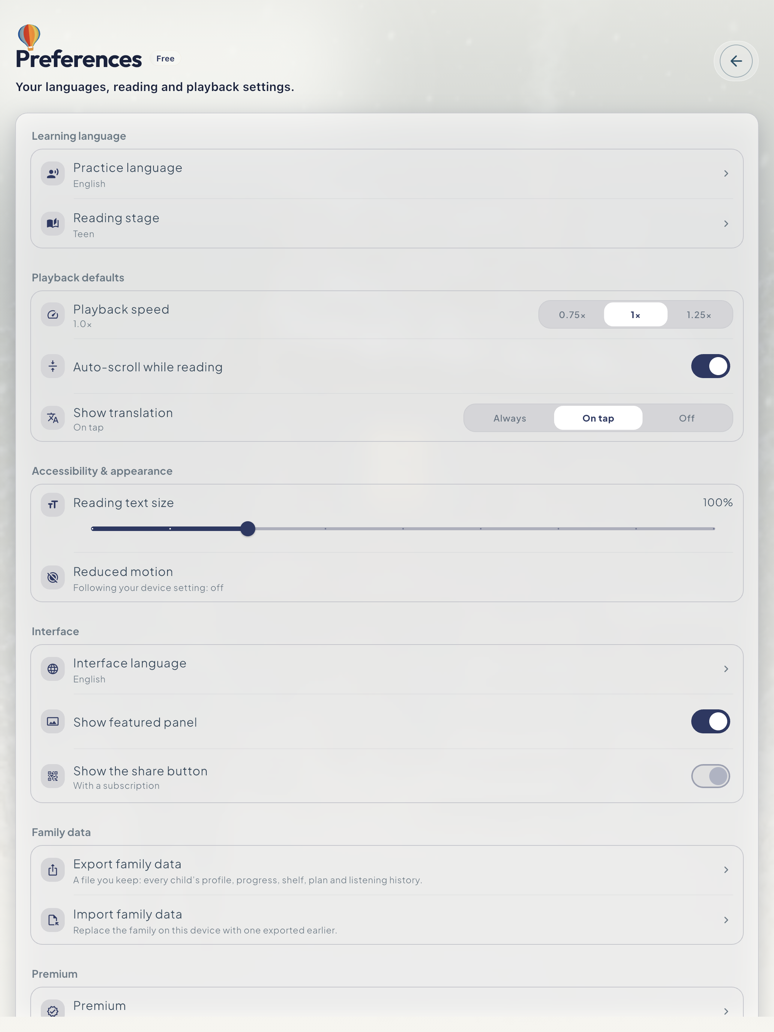
Early reader, growing reader and teen. The stage is set per child, here, alongside the language — and what it changes is further up this page, in pictures.
Nothing about your child leaves the device
This is not a promise about how carefully data is handled somewhere else. There is no somewhere else.
Progress, listening history, child profiles, achievements, plans and reports are stored on your phone or tablet. The server LimaRead talks to sends books. It is never told what was read, for how long, or by whom.
A child profile is a name, an animal drawn in code, a reading stage and a language. No photograph. No date of birth. No account for the child, and no sign-in to read.
The weekly report is made on the device and becomes a PDF only when you ask for one, and it goes wherever you send it. The whole family — children, settings, progress, plans, awards, history — exports as one plain readable file, so you can open it and see that it is yours and nothing more.
Deleting a child deletes that child's record, and says so before it does it.
This page is the same idea: no cookies, no analytics, no fonts or scripts fetched from anybody else. There is nothing here to consent to.
It works on a plane, in a car, and in a cellar
A downloaded story carries everything it needs.
The audio, the text, the word timings and every picture are inside the book you downloaded, so a story plays through with the network switched off entirely. The library keeps working from what it has already stored; reports, achievements and the family area never needed a connection in the first place. A book that has not been downloaded says exactly that, with one thing to do about it.
What is free, and what it costs
Listen to the first six books in every language and reading group for free.
Start free
The first six books in every language and every reading group play all the way through. No sign-up, no payment details, no time limit.
The rest of the library is visible, so you can see what is there; it opens with a subscription, along with child profiles, reports, reading plans, child mode and offline downloads.
Monthly
$9.99 per month
$119.88 over twelve months
Billed every month. Cancel any time in your store account.
Best value
Yearly
$79.99 per year
About $6.67 a month — you save about $3 a month
Billed once a year — about a third less than twelve monthly payments. Cancel any time.
Prices are in USD; the store shows the final price for your country before you confirm. A subscription is bought inside the app, through the store you install from, and cancelled there.
Questions parents ask
How old do the children need to be?
LimaRead is for ages 3 to 17, in three reading stages: early reader (3–6), growing reader (7–11) and teen (12–17). The stage is set per child and decides what is on the shelf and how the page is laid out.
Is it really free to start?
Yes. The first six books in every language and reading group play all the way through, with no time limit and no sign-up. A subscription opens the rest.
Which languages are there?
Six. Every story exists in all six, recorded in each language, so a child can read it in the language they have and then meet the very same story in the one they are learning.
Does it work without internet?
Downloaded books carry their audio, text and pictures, so they play with the network switched off. A book that has not been downloaded needs a connection first.
What happens to my child’s data?
It stays on your phone or tablet. A child profile is a name, an animal, a reading stage and a language — no photograph, no date of birth — and the server is never told what was read.
How do I cancel?
Any time, in your store account (Google Play or the App Store). A subscription is bought, and cancelled, through the store you installed from.
Can my child use it alone?
Yes. Child mode is a calm reading space for your child; the parent settings stay behind a PIN.
For schools and kindergartens
Reading aloud in a group, in the language you are teaching.
LimaRead School is coming soon. If your school or kindergarten is interested, write to us: [email protected]
LimaRead runs on a tablet or a phone, with no account for the child and no sign-in to read. Each child gets a profile with a name, an animal, a reading stage (ages 3 to 17) and a language; nothing about the children leaves the device, and downloaded books work without a connection.
Get it
LimaRead is in both stores. Install it on the device your child reads on — the first six books in every language are free.

Android

iPhone and iPad

What you can count on
- Nothing about your child leaves the device.
- No account for the child, no photograph, no date of birth.
- No cookies and no analytics on this page.
- Cancel any time in your store account.

For whoever is reading this
Paper books are getting rarer, and fewer children now meet the stories our own childhoods were made of.
Here they are read aloud instead, a page at a time, in the language you are learning. The fox is still under the tree. The princess is still asleep in the wood. Captain Nemo still steers his submarine through the deep, and a raft is still drifting down the great river. They all waited.
Now it is your turn to find them.
— the people who made LimaRead